
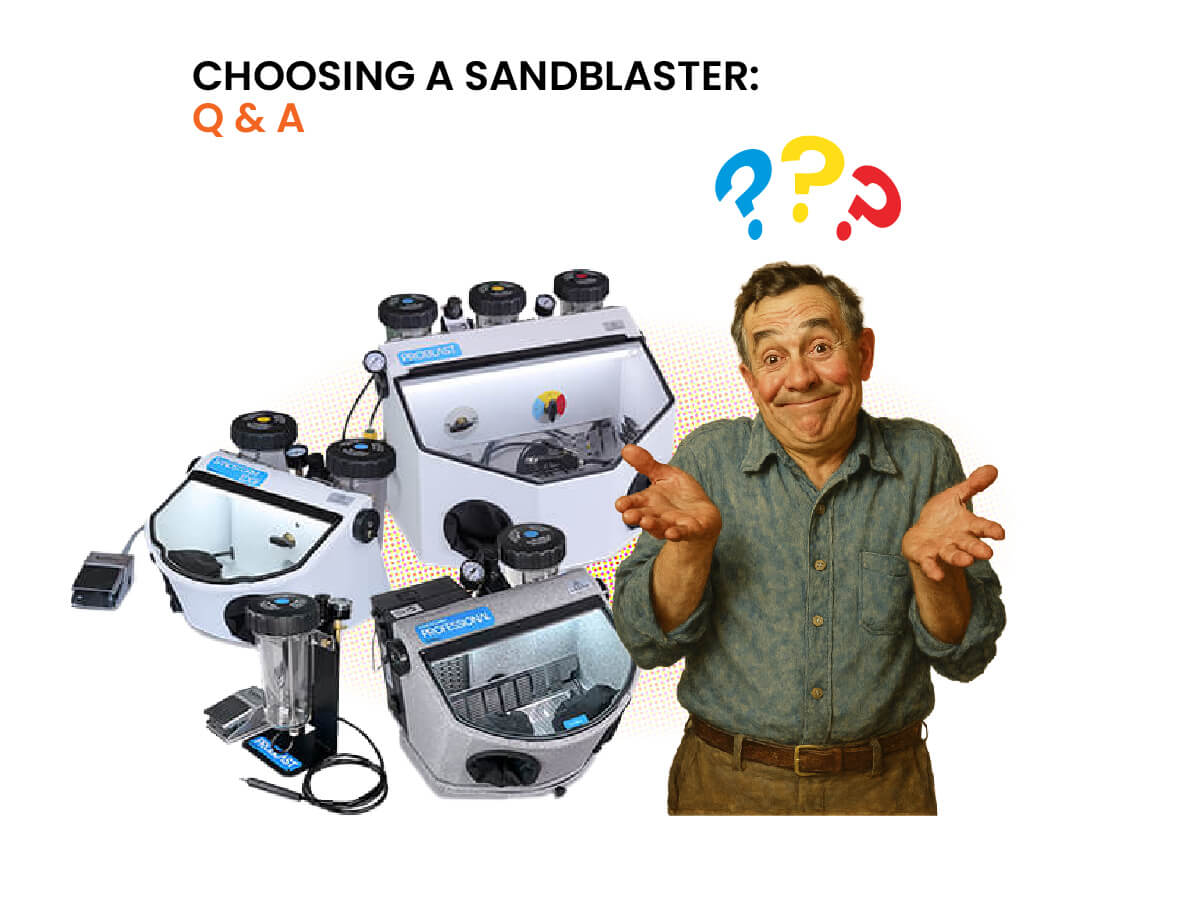
So you need a microabrasive sandblaster — no problem, right? There’s no shortage of sandblasters in the world.
But what kind of sandblaster do you need? There are many brands and models to choose from, so where do you begin?
Luckily, you can narrow down your search with the right series of questions. If you’re in the market for a microabrasive sandblaster, here are the most useful questions to ask:
What is the intended use/application?
There are all kinds of micro sandblaster applications out there, and knowing what you’re going to do is where you should start your hunt.
What exactly are microabrasive sandblasters good for?
- Deburring
- Deflashing
- Surface texturing
- Roughing/rusticating
- Metal finishing
- Polishing
- Cleaning oxidized processes or materials
- Fossil prep (matrix removal)
- Glass etching
- Restoration
- Sandcarving
- …and more!
When you know what it is you’re going to do, the rest of blaster shopping should come naturally and easily.
Additional questions you should ask include:
How many sand tanks are needed?
- More tanks means more workflow convenience — less time spent refilling empty sand tanks or swapping one tank for another.
- Multiple tanks also helps avoid cross-contamination of blasting media. If you have one dedicated tank for each type of media you’ll use, you don’t need to empty and clean a tank before filling it up again with a different kind of media.
- Pro tip: Vaniman’s sand tanks are interchangeable across all our blaster models. If you have more types of media to use than tanks available on the blaster, you can purchase tanks separately and swap one for the other as needed.
Does this system include instant-off control?
Several of Vaniman’s blasters have an instant-off variant available. On our standard blasters, the tank pressurizes and depressurizes each time you step on and off the pedal, leading to some media bleed-off when you stop the flow. The instant-off variants use a continuously pressurized tank and pinch valves to cut off the flow immediately when you step off the pedal.
Here are some questions to help you decide between the two types:
- How long will I sustain blasting? (Longer sustained blasting usually does not require instant-off functionality.)
- How delicate is the target I’m blasting on? (Do I need to avoid media touching other parts beyond just the specific target zone?)
- Is your work artisanal in nature? (Do I need specific precision control vs. general area coverage?)
Get more details here: What’s the Difference Between Our “Master” or Instant-Off (I/O) Sandblasters and the Standard Kind?
Is there long-term support?
What happens if I have a problem with this blaster?
- Vaniman’s customer support is always here for you. If a problem arises, simply reach out and you’ll connect with a real human being who can walk you through any troubleshooting that needs to happen. You’ll never be offhanded to a non-human chatbot.
- You can catch us on our chat feature on our website, via our contact form, or by phone at +1 (760) 723-1498.
Do you stock parts for systems manufactured 10 years ago?
- It’s very rare for Vaniman NOT to stock parts for older models. In almost all cases, you’ll be able to replace the parts, even if the model is from the distant past and has been discontinued.
What is the average lead time for non-stock replacement parts?
- Most replacement parts are kept in stock at Vaniman’s warehouse, meaning most replacement parts ship within a couple business days.
- In the rare case we are out, lead time can be a couple of weeks, and we will communicate fully as timing information becomes more clear.
Can you provide a parts diagram for replaceable components?
- Vaniman always includes various replacement parts with the printed instructions for every blaster we sell.
- You can also find those instructions in PDF form on each product page (in case you threw the instructions away years ago like any normal person would).
How much benchtop space is available?
- Vaniman’s lineup of sandblasters ranges from small portable units to large cases a couple feet wide. You’ll want to know how much space is available for the blasting system before making your purchase. If you cannot find the information you need on each product page, please contact Vaniman and we’ll get your answer to you right away.
- What will your complete setup look like? If you are integrating a microabrasive sandblasting system into a larger series of tools and equipment, be sure you’ve got the space dedicated before you invest.
- For internal cabinet working space, see each blaster’s specific product page; this will tell you if it’s big enough to contain what you’re blasting on.
Don’t forget about dust collection…
- What cabinet volume does this dust collector support?
- What is the actual operating noise level?
- Our single-station dedicated dust collectors designed for sandblasters are literally whisper-quiet at 54 dBA (a typical human conversation is around 60 dbA).
- Our larger StoneVac units are a little louder — the tradeoff for more suction power.
- How often will I need to replace a filter?
- This depends on a) what kind of filter your dust collector uses, and b) how heavy the volume of work is.
- A Vaniman filter bag should be replaced when it’s about half full; a standard time recommendation is every three months.
- A Vaniman HEPA filter cartridge should be replaced every six to twelve months, depending on how often it is used.
- Note: we always recommend a dust collector with an Accumulator for blasting media, which will capture and separate out 95-99% of the particulates before they enter the dust collection unit (and thus the filter), so the replacement of filters can be considerably less frequent than the standard recommendation. You will save plenty of money by using the Accumulator.
- This depends on a) what kind of filter your dust collector uses, and b) how heavy the volume of work is.
Contact Vaniman if you need more answers
We’re here to help. Reach out to us today with any questions about our blasters or dust collectors!