
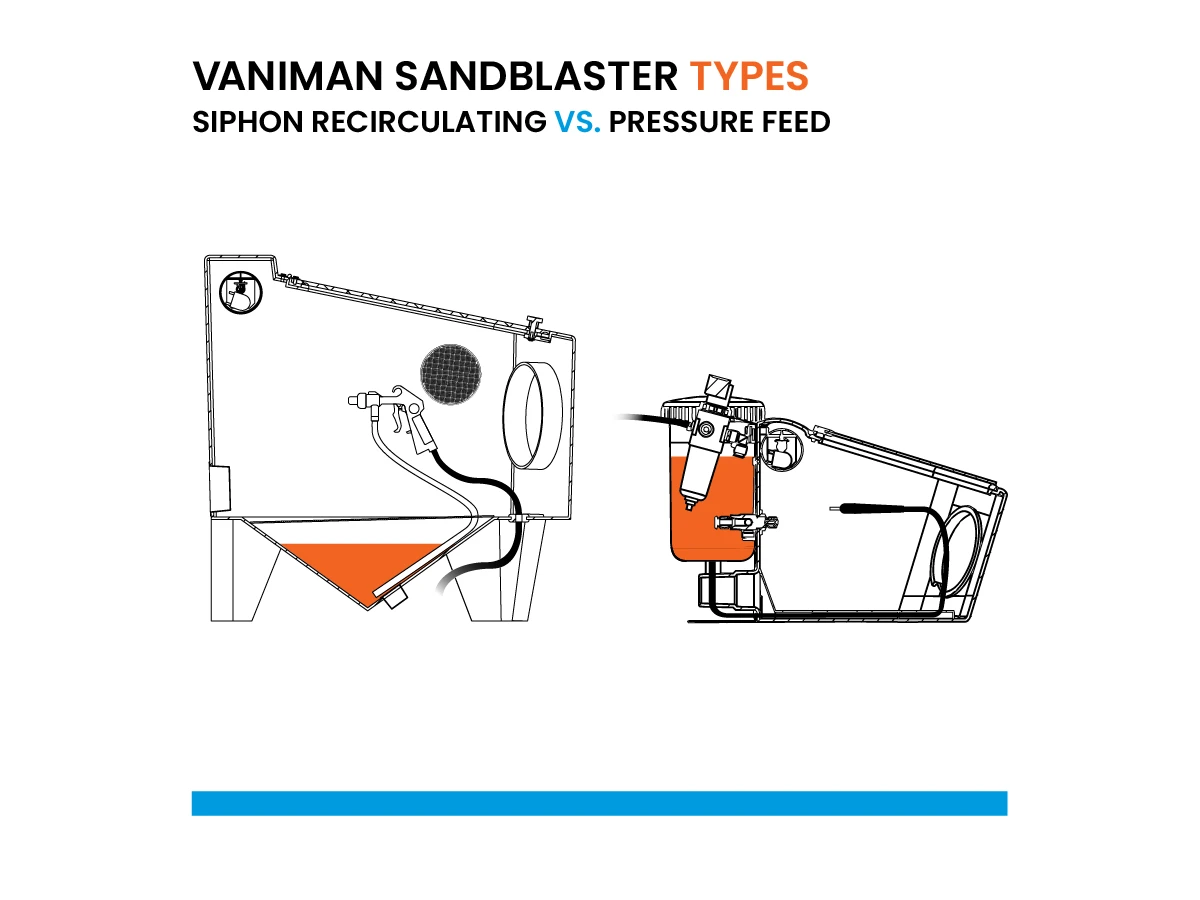
Question: What is the difference between a siphon blaster and a pressure feed blaster?
Different types of microabrasive sandblasters use different performance characteristics to offer different results. As a general rule, siphon recirculating blasters are more specialized (read: narrower) in terms of application, whereas pressure feed blasters provide a wider range of uses and applications.
Let’s break down those differences real quick:
Siphon recirculating blasters
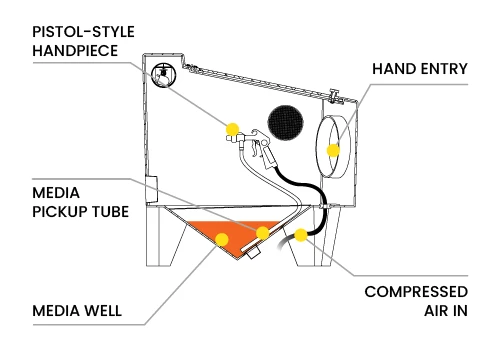
Our siphon blasters keep the media inside the cabinet. The pistol-shaped nozzle has a pickup tube that reaches down into the reservoir at the bottom. Air is pushed through the nozzle from the outside compressor to create negative pressure in the pickup tube, which pulls up the media and then pushes it out the nozzle tip.
Pros of siphon blasting:
- Media is recirculated in the cabinet, keeping media consumption as low as possible
- Allows for larger particulate blasting media
Cons of siphon blasting:
- Less precision and control than pressure-feed blasters
- PSI adjustment only at compressor
Best used for:
- Polishing
- Buffing
- Delicate cleaning
- Broader-area surface texturing
Pressure feed blasters
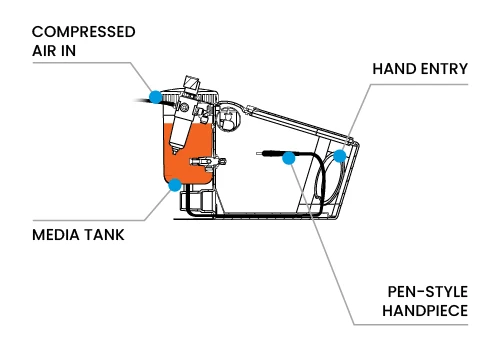
Pressure feed microabrasive sandblasters work differently. The compressed air is fed into the external sand tanks to pressurize them, and the pressure is released with media through the tubing through the handpiece when the pedal is depressed. (Read about the differences between standard pressure feed sandblasters and instant-off variants here.)
Pros of pressure feed blasting:
- Greater precision and control
- Greater speed and efficiency
- Extremely fine detail (down to 25 micron media)
- Convenient PSI adjustment at blaster cabinet
- Greater variety of models available (including instant-off variants)
Cons of pressure feed blasting:
- Media is consumed, and is generally not recyclable
Best used for:
- Deburring
- Deflashing
- Surface texturing
- Pre-bonding surface prep
- Matrix removal
- Glass etching
- Post-3D print parts processing
- Cleaning
- Polishing
- Oxidation removal
- Rustication
- Conformal coating removal (ESD units only)
- …and much more!